Ilusratons
Each illustration is hand-drawn in ink and engages the visual language of vintage advertising as both subject and medium. Borrowing the authority of slogans, typography, and commercial aesthetics, these works redirect persuasion away from consumerism and toward inner experience, symbolic perception, and the realm of dreams. Rather than instructing or defining meaning, each poster creates a space of reorientation, inviting viewers to reconsider the myths that shape contemporary life, and to encounter dreaming as a way to access the deeper stories that help guide and shape our lives for the better.
Reclaiming the American Dream, one advertisement at a time.
Advertising is one of the most powerful myth-making systems of contemporary culture, shaping desire, identity, and collective imagination by organizing how we understand success, happiness, value, and selfhood.
My work engages this visual language as both subject and medium through hand-drawn ink posters that appropriate and reconfigure the aesthetics of vintage advertisements, including typography, slogans, and declarative statements. While these images resemble familiar commercial forms, they resist the logic of selling, redirecting the persuasive authority of advertising away from consumerism and toward inner experience, symbolic perception, and dream imagery. They function as invitations back into the realm of authentic, life-supporting myth.
Traditional cultures understood myth not as fiction but as lived orientation, providing continuity, coherence, and psychological grounding by situating individuals within a larger order of meaning that included nature, ancestry, and time beyond the individual lifespan. Modern culture, by contrast, has largely relocated myth into market systems, where narratives of acquisition, productivity, youth, and status have become dominant organizing stories that, while powerful, often narrow identity and bind it tightly to external conditions.
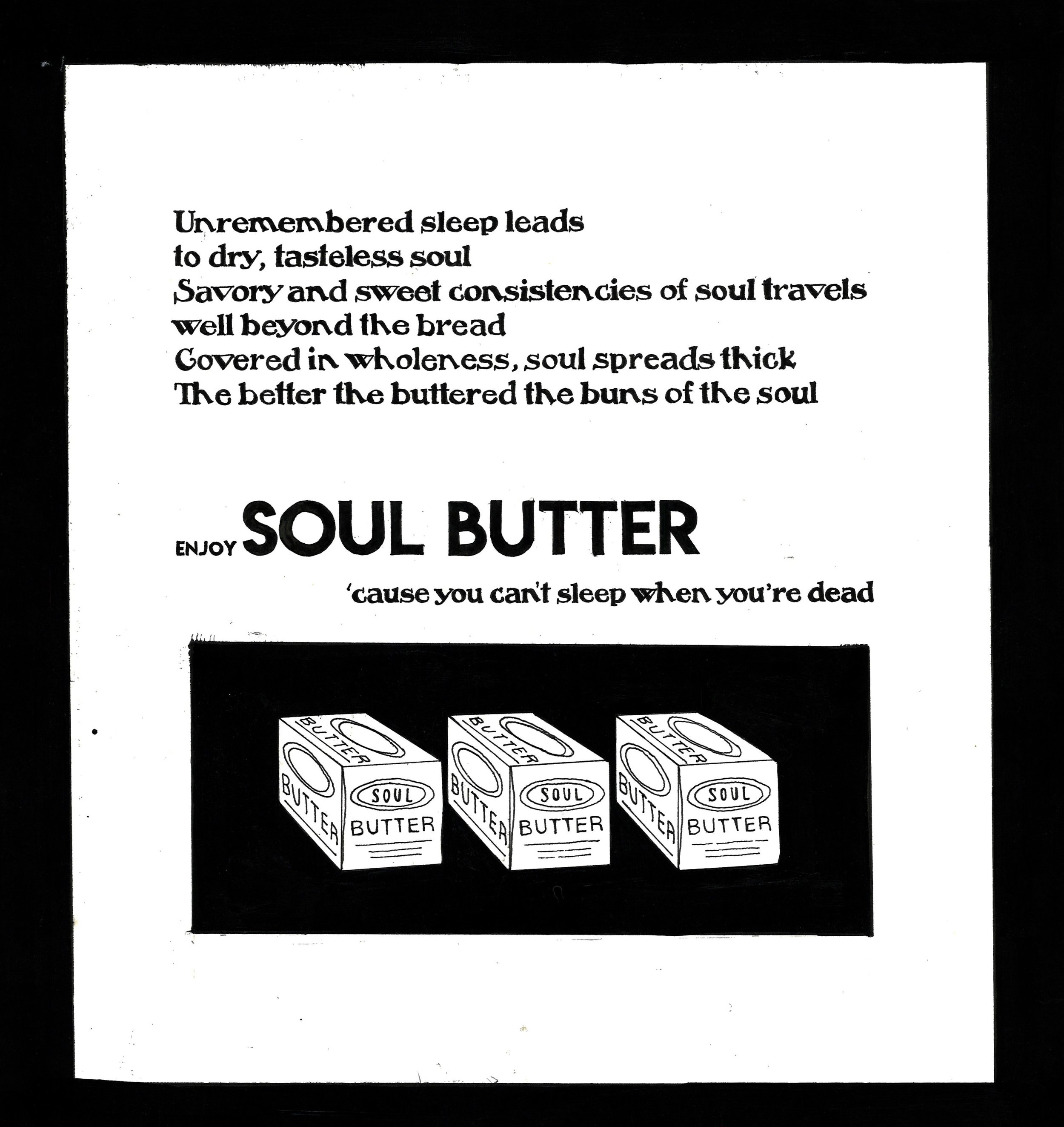
“My work explores the possibility of growing a new mythology for contemporary Western life, one that cannot be inherited through fixed ideologies but must be accessed through direct experience. Dreaming offers such an access point. Dreams are universal, biologically inherent, and largely independent of cultural conditioning, exposing individuals to symbolic narratives, emotional intensities, and archetypal patterns that expand identity beyond waking roles and circumstances. In this sense, dreaming is not merely personal but cultural, cultivating imagination, emotional intelligence, and cognitive flexibility while placing us in contact with mythological time: nonlinear, symbolic, and unconstrained by ordinary reality structures.
By echoing advertising while pointing toward dream logic, symbolic identity, and imaginal experience, these works gesture toward a decentralized mythology, one that must be personally encountered, interpreted, and lived. Rather than defining meaning, the posters open perceptual space, inviting viewers to reconsider the myths they inhabit, the stories that shape them, and the possibilities available when Dreaming is reclaimed as an indispensable practice for living.”
TIME
Inspired by vintage American newspapers and advertising, this work comments on the distortion of the word ‘dream’ to mean ‘lofty, consumerist aspiration’ rather than ‘concrete metaphysical experience’ - and how that little re-definition shapes our culture. Modern advertising mythologizes ‘The American Dream,’ replacing the role of sacred myth with a materialistic idealism in which success, wealth, accumulation, and consumption define meaning and legacy. In this shift, the use of the term ‘Dream’ has obscured one of our last direct connections to mythic time: our literal dreams and dreaming as a lived cultural practice.
Our ancestors did not experience Myth as fiction, but as living reality, accessible through sacred acts and processes, and foundational to social life, culture, and identity. They recognized two kinds of time: historical time and mythological time, profane time and sacred time. Modern life, nearly entirely secularized, draws meaning primarily from profane time, often at the expense of the deeper life of the psyche. As Jung observed, myths risk becoming “words and gestures deprived of life.”
This work gestures toward a reorientation. It proposes dreaming as a contemporary site of sacred experience, a space where meaning, symbolism, and non-linear time remain directly accessible to each of us.
By reconsidering dreams not as fantasy or aspiration but as experience, the work explores how a shared yet deeply personal dreaming practice may reopen questions of purpose, perception, and our relationship to time itself.
COMPLETE GALLERY